
Borjomi & Bakuriani Guide: Hot Springs, Forests & Mountain Air
Georgia — the Caucasus country between Europe and Asia, not the US state — is known for dramatic mountains, ancient monasteries, and wine country. But there's a quieter side to the country that most itineraries rush through: the forested gorge of Borjomi, where the air is cooler, the pace is slower, and the mineral water is terrible in the best possible way.
If you've ever seen a bottle of Borjomi mineral water on a shelf — and across the former Soviet Union and half of Europe, you have — this is where it comes from. A spa town built around natural springs in a densely forested valley, Borjomi has been attracting people seeking rest and fresh air since the 1800s. The Russian Imperial family built a summer palace here. The Soviet elite followed. Today, it's a stop on any serious Georgia itinerary, and a natural companion to the cave monasteries of Vardzia an hour and a half to the south.
Thirty minutes uphill from Borjomi, the mountain resort of Bakuriani adds skiing, hiking, and one of Georgia's most charming railway journeys to the picture.
Why Visit Borjomi
The mineral water. Borjomi's warm, sulfurous spring water has been famous since the 19th century. Drinking it from the source — warm, flat, and pungent — is a rite of passage. It tastes nothing like the carbonated, chilled version you buy in bottles. It tastes, frankly, awful. Everyone does it. You will too.
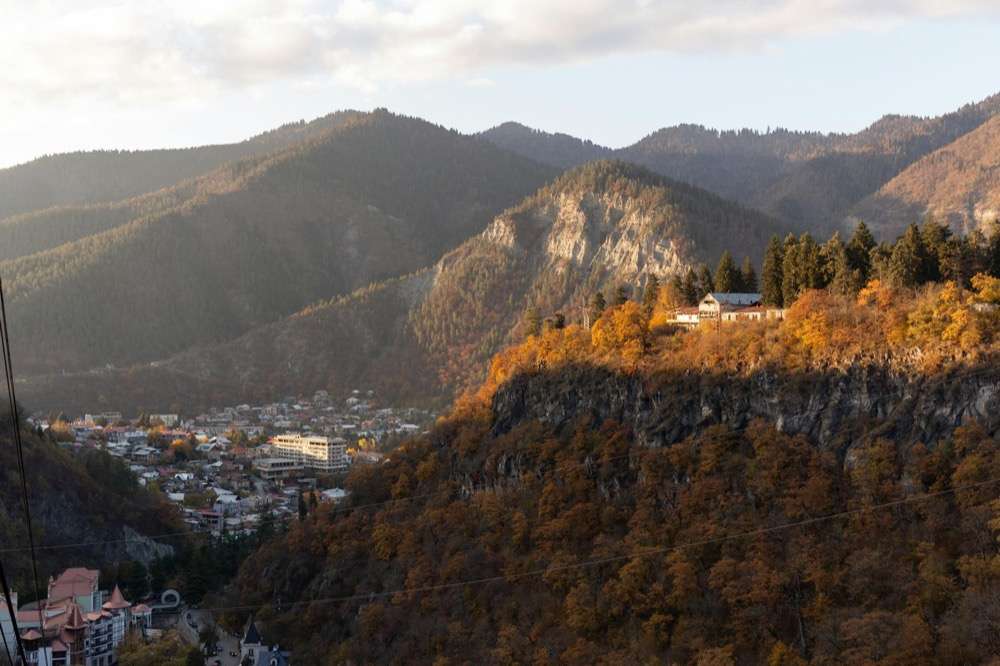
The forest. Borjomi sits in a deep gorge where the Borjomula River meets the Mtkvari. The forested hillsides create a microclimate that's noticeably cooler and fresher than Tbilisi, even in summer. The air quality difference is immediate and dramatic — step off the bus and you'll feel it in your lungs.
The pace. This is not a "sights" destination. Borjomi is a "sit down, breathe, walk slowly, eat lunch" destination. After days of Kazbegi mountain drives, Uplistsikhe cave scrambles, and Vardzia cliff monasteries, a day in Borjomi's park feels like exhaling. That's the point.
The gateway. Borjomi is the natural base for exploring southern Georgia — Vardzia is 1.5-2 hours south, Bakuriani 30 minutes up, and the vast Borjomi-Kharagauli National Park surrounds the town. If you enjoy Georgia's thermal and wellness traditions, Borjomi is the countryside counterpart to Tbilisi's sulfur baths.
How to Get to Borjomi
Borjomi is about 160 km west of Tbilisi, in a river gorge that feeds into the broader Kura valley.
| Route | Method | Time | Cost | Notes |
|---|---|---|---|---|
| Tbilisi → Borjomi | Marshrutka | 3-4 hrs | 10-12 GEL ($4) | From Didube station |
| Tbilisi → Borjomi | Train | 4-5 hrs | ~10 GEL ($4) | Scenic gorge approach |
| Tbilisi → Borjomi | Private car / taxi | 2.5 hrs | ~$60-80 | Fastest, most flexible |
| Vardzia → Borjomi | Car | 1.5-2 hrs | — | Via Akhaltsikhe |
| Kutaisi → Borjomi | Car | 2.5-3 hrs | ~$50-70 | Via Khashuri |
If you're visiting both Vardzia and Borjomi — and you should — drive. The train to Borjomi is scenic but slow, and marshrutkas don't stop at sites along the way. A private driver for the Tbilisi → Borjomi → Vardzia loop costs $80-120 per day and gives you complete flexibility. See our getting around Georgia guide for all transport options.
Things to Do in Borjomi
Borjomi Central Park & Mineral Springs
The park is the heart of Borjomi — a long, tree-lined stretch along the river with walking paths, small carnival rides, cafes, and the mineral water source at the far end. The atmosphere is relaxed and family-friendly: couples strolling, kids on rides, older locals sitting on benches.
At the end of the main path, you'll find the source — a fountain where warm mineral water flows freely. Fill a cup, take a sip, and try to keep a straight face. The tradition is to drink it for health. The reality is that it smells like sulfur and tastes like someone dissolved a geology textbook. But you came all this way.
The park entrance is free. Some inner sections charge a small fee (2-3 GEL).
The mineral water from the source is warm (around 38-40°C), flat, and strongly sulfurous. It's nothing like the bottled Borjomi you buy in shops — that's carbonated, chilled, and significantly more palatable. Bring a cup or bottle, or buy one from vendors at the park entrance. Locals believe the water helps with digestive and kidney issues.
Cable Car
A short cable car ride from the park takes you above the gorge for panoramic views of the forested valley. The ride is about 5 minutes each way and gives you a sense of just how deeply Borjomi is nestled into the landscape. From the top, you can hike back down through the forest if you prefer legs to cables.
Cost: about 5 GEL ($2) round trip. Runs year-round, weather permitting.
Romanov Palace (Likani)
Ten minutes by car (or a 20-minute walk) from the park, the Romanov Palace in Likani village was the summer residence of the Russian Imperial family's Caucasus branch. Grand Duke Nikolai Mikhailovich built the current structure in the 1890s in a Moorish-Gothic style that feels unexpected in a Georgian gorge.
After the revolution, it became a Soviet government dacha. Today, parts of the palace and grounds are open to visitors. The architecture is the main draw — ornate facades, arched windows, a setting in manicured gardens with the forest rising behind. Entry is about 5 GEL.
Borjomi-Kharagauli National Park
One of the largest protected areas in the Caucasus, Borjomi-Kharagauli covers over 85,000 hectares of forest, alpine meadows, and mountain peaks surrounding the town. The park has a network of marked hiking trails ranging from easy day hikes to multi-day routes with overnight shelters.
Popular trails include the route to Likani Plateau (moderate, 4-5 hours round trip) and the longer trek to Lomismta summit (challenging, 2-day route with a shelter). Registration at the visitor center in Borjomi is required before setting out.
If you only have one day in Borjomi, skip the national park and focus on the Central Park, cable car, and Romanov Palace. The national park trails are best for visitors spending 2+ days who want serious hiking. The visitor center can advise on trail conditions and book shelters.
Green Monastery (Chitakhevi)
About 12 km from Borjomi, the Green Monastery is a 9th-century church complex set deep in the forest. It gets its name from the moss and greenery that covers virtually every surface — walls, roofs, gravestones. The effect is atmospheric and quietly beautiful, especially in morning light when mist hangs in the trees.
Free to visit. Worth a short detour if you have a car. The access road is passable but not great.
Bakuriani: Mountain Escape 30 Minutes Away
Bakuriani sits at about 1,700 meters in the Trialeti Range, a 30-minute drive up a winding mountain road from Borjomi. It's a different world from the gorge below — open meadows, mountain views, pine forests, and air that's even crisper than Borjomi's. Originally developed as a ski resort in the Soviet era, Bakuriani has evolved into a year-round mountain destination.
The Kukushka Railway
The narrow-gauge railway connecting Borjomi to Bakuriani is one of Georgia's most charming transport experiences. Built in the 1890s by the Romanov administration, the "Kukushka" (named for its whistle) climbs 900 meters through forests and across bridges on a route that takes about 2.5 hours.
The train is slow, rattly, and beautiful. It runs daily in both directions. A one-way ticket costs about 2 GEL ($0.80). Check the schedule locally — departure times shift seasonally, and the train doesn't always run if passenger numbers are very low.
Winter: Skiing & Snow
Bakuriani's ski season runs from December through March. The resort is family-friendly and significantly less intense than Gudauri — lower altitude, gentler slopes, and a more relaxed atmosphere. Runs are best suited for beginners and intermediates. Equipment rental is available and affordable (about 30-40 GEL per day for a full set).
The resort has been modernized in recent years with new lifts and improved facilities, but it still feels more like a mountain village than a purpose-built resort. Lift passes cost about 25-35 GEL per day.
Summer: Hiking & Fresh Air
In summer, Bakuriani transforms into a hiking and mountain biking base. Trails radiate into the Trialeti Range, and the meadows around town burst with wildflowers. Horseback riding is available through local operators. The cooler temperatures (15-22°C when Tbilisi bakes at 35°C) make it a popular summer escape for Georgian families.
Bakuriani is not on our tour itinerary, but if you have an extra day in the Borjomi area, the Kukushka railway ride alone is worth the trip. Take the morning train up, explore Bakuriani for a few hours, and return by car in 30 minutes (or ride the train back if timing works).
Where to Stay in Borjomi
Borjomi is compact and walkable. Most accommodation is within 10-15 minutes of the park.
- Budget ($25-40/night): Guesthouses and family-run pensions. Clean, simple, and often include breakfast. The host may insist on feeding you more than breakfast. Let them.
- Mid-range ($40-80/night): Boutique hotels and renovated Soviet-era properties. Better amenities, some with garden terraces and park-adjacent locations.
- Splurge ($100+/night): Crowne Plaza Borjomi. Pool, spa, modern rooms, the only truly upscale option in town. Worth it if you want the full wellness experience.
Accommodation in Borjomi is significantly cheaper than Tbilisi for comparable quality. Even in peak summer, you'll find good options under $50.
Where to Eat
Borjomi is not a food destination in the way Tbilisi or Kakheti are, but the restaurants are solid and the pace of meals here is unhurried — which is the point.
- Pesvebi — Georgian comfort food in a cozy setting. Reliable khachapuri, kebabs, and stews. The go-to spot for most visitors and locals.
- Park-adjacent cafes — Several restaurants line the entrance to Borjomi Central Park. Quality varies, but you're paying partly for the setting — river views, forest backdrop, no rush.
- Guesthouse meals — If you're staying in a family-run guesthouse, eat there. Georgian guesthouse dinners are often the best meals of any trip.
For the full rundown of Georgian dishes to order anywhere in the country, see our food guide.
Combining Borjomi with Vardzia: The Southern Georgia Route
Borjomi and Vardzia are on the same north-south axis and combine naturally into a 2-3 day loop from Tbilisi. Here's how it works:
Day 1: Tbilisi to Borjomi (2.5 hours by car). Afternoon in Borjomi: Central Park, mineral water, cable car, Romanov Palace. Stay overnight in Borjomi.
Day 2: Borjomi to Vardzia (1.5-2 hours via Akhaltsikhe). Stop at Rabati Castle in Akhaltsikhe if time allows — a restored medieval fortress worth 30-45 minutes. Explore Vardzia in the afternoon. Return to Borjomi or stay near Vardzia.
Day 3 (optional): Bakuriani day trip via Kukushka railway, or a hike in Borjomi-Kharagauli National Park. Return to Tbilisi.
This is essentially what Days 5-6 of our 8-day itinerary cover, and it's also a great standalone road trip if you're planning day trips from Tbilisi independently.
When to Visit Borjomi
| Period | Weather | Activities | Crowds | Verdict |
|---|---|---|---|---|
| Jan–Mar | Cold, snow possible, 0-5°C | Bakuriani skiing, quiet park | Very low | Winter sports focus |
| Apr–May | Warming, 12-18°C, some rain | Hiking starts, park greening | Low | Good shoulder season |
| Jun–Aug | Warm, 22-28°C, occasional rain | Everything open, national park | Medium-High | Peak season |
| Sep–Oct | Cooling, 15-22°C, autumn colors | Hiking, park, fewer crowds | Medium | Best months |
| Nov–Dec | Cold, rain/snow, 3-8°C | Pre-ski, quiet town | Low | Atmospheric but limited |
September and October are the sweet spot. Warm enough for outdoor activities, autumn colors in the gorge, and fewer visitors than summer. Borjomi is also notably cooler than Tbilisi year-round — a bonus in summer, something to dress for in spring and autumn. For a full seasonal breakdown across Georgia, see our month-by-month guide.
Borjomi on Our Tour
Day 6 of our 8-day Grand Highlights tour is spent entirely in Borjomi. And that's deliberate.
By Day 6, you've driven the Georgian Military Highway to Kazbegi, scrambled through 3,000-year-old caves at Uplistsikhe, and stood inside Vardzia's cliff-carved monastery. It's been extraordinary — and intense. Day 6 is when we stop.
The mineral springs in the morning. The cable car for views. The Romanov Palace for a slow wander. A long lunch under the trees. An afternoon with nothing on the schedule. Most tour operators treat Borjomi as a quick stop between Vardzia and the next destination. We give it a full day because travel shouldn't feel like a checklist — and because sometimes the best thing a tour can do is know when to slow down.
Borjomi Is Day 6 of Our Tour
After Kazbegi and Vardzia, Day 6 is a deliberate pace break — mineral springs, cable car, Romanov Palace, and a long lunch in the forest. 8 days, max 10 guests.
See what all 8 days look like — from Tbilisi's cobblestones to Kazbegi's peaks to Borjomi's mineral springs — explore the full itinerary →
Borjomi is famous for its mineral water, which has been bottled and exported since the 19th century. The town sits in a forested gorge with natural hot springs, a scenic cable car, and a former Romanov summer palace. It's Georgia's premier wellness destination.
By marshrutka from Didube station (3-4 hours, 10-12 GEL), by train (4-5 hours, ~10 GEL), or by car/private driver (2.5 hours). The car is fastest and most flexible, especially if combining with Vardzia.
Yes. Borjomi offers a genuine change of pace — cooler air, dense forest, mineral springs, and a relaxed spa-town atmosphere. It's also the gateway to Vardzia and Bakuriani, making it a natural stop on any southern Georgia route.
Yes. Bakuriani is a family-friendly ski resort 30 minutes from Borjomi with runs for beginners and intermediates. The season runs December through March. In summer, Bakuriani offers hiking and mountain biking.
Yes — Day 6 of our 8-day Grand Highlights tour is spent entirely in Borjomi. It's a deliberate relaxation day after the intensity of Kazbegi and Vardzia, with time for mineral springs, the cable car, Romanov Palace, and a long lunch.